
Is Running Bad for Your Knees?
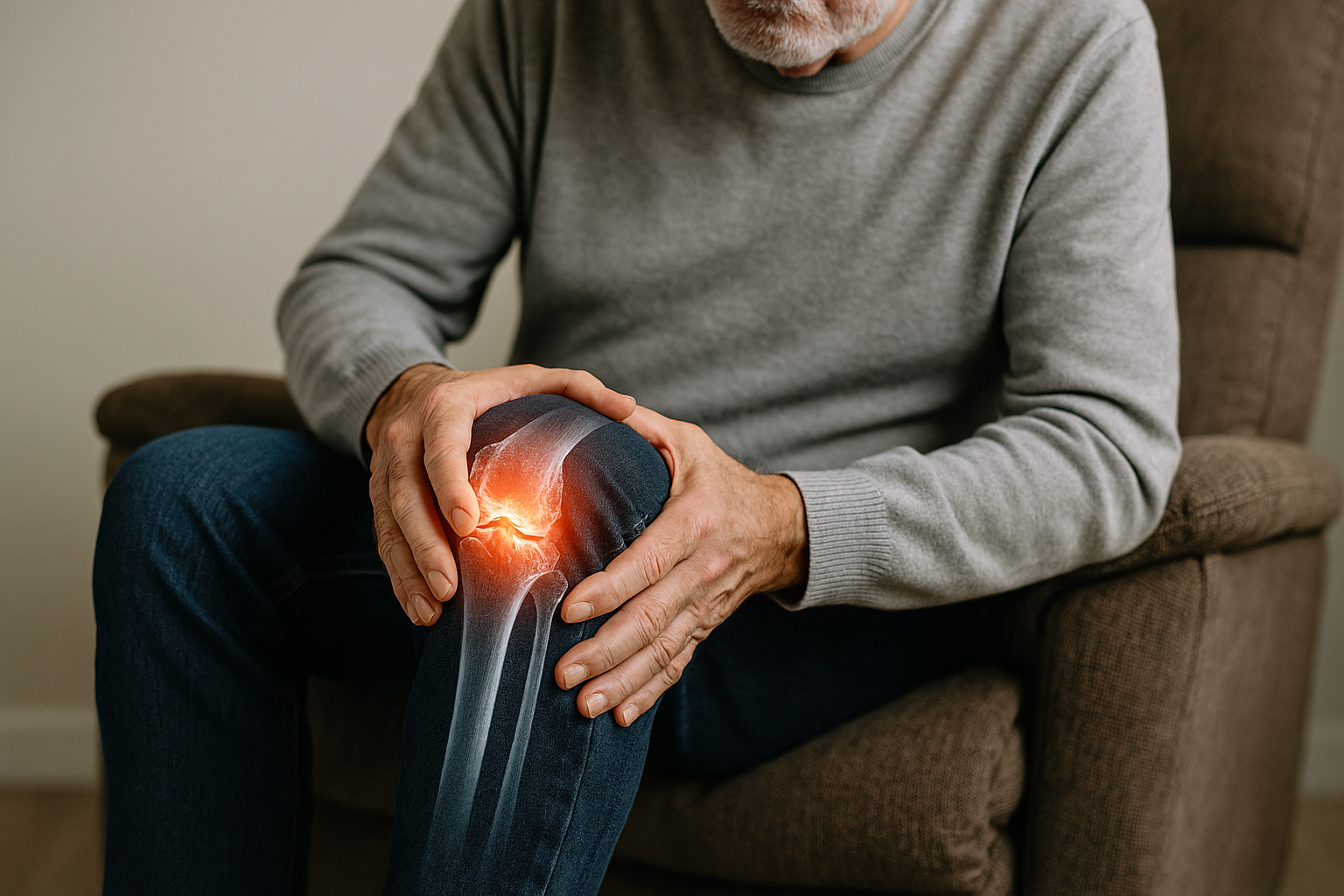
“Is running bad for your knees?” is probably one of the most common questions I get. People come in worried that running has worn their knees down, or that running years ago is now catching up with them. It doesn’t help that even a lot of medical professionals use the phrase “wear and tear” when describing osteoarthritis, which makes it sound like your knees are car brakes that eventually grind down to nothing. But does the evidence actually back that up?
Does running actually cause knee arthritis?
The main premise is that running causes damage to the knees and therefore would increase knee pain and specifically osteoarthritis (OA). If this were true we should see higher rates of osteoarthritis in adults who run compared to those who don’t. Luckily, this has been researched¹. This systematic review of over 100,000 people analyzed both hip and knee OA. It showed a lower occurrence of OA in recreational runners compared to sedentary people, and a U-shaped curve for risk of OA, meaning that sedentary people had a higher risk, recreational runners had a lower risk, and then once you got into higher mileage per week the risk increased again.
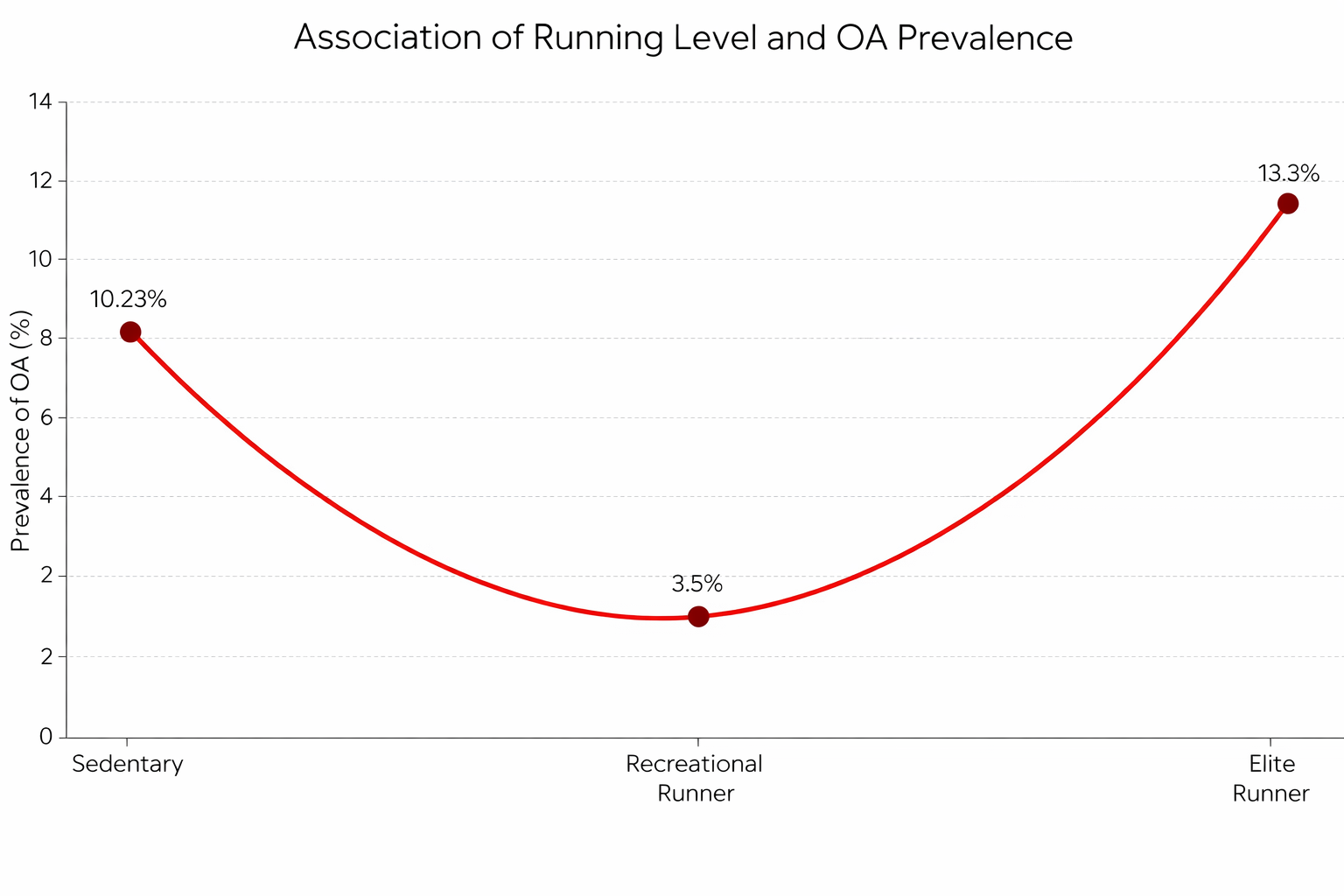
Research from Alentorn-Geli 2017 shows recreational runners actually have lower rates of osteoarthritis compared to sedentary people.
The good news here is that for the vast majority of people running seems to actually be protective against developing OA rather than the cause of it.
A more recent systematic review again looked at the link between running and knee osteoarthritis². It followed 14,000 participants and found that runners had lower knee pain prevalence than non-runners, no difference in OA on an x-ray, and were less likely to get a total knee replacement than non-runners. This again seems to show that for most people running does not seem to cause problems with OA or knee pain and may even be beneficial.
How much is too much?
At this point we can be confident that for the majority of people running will actually have positive effects on knee pain and osteoarthritis. However, as we saw in the chart above, elite level and competitive runners may have higher rates of osteoarthritis. There is some nuance around this finding to consider. Many of the elite and competitive runners in the study were previously professional athletes or elite competitors. It is common to see higher rates of OA in athletes across many sports including football, basketball, and soccer. So this may not be a particularly surprising finding given the tradeoffs that come with being a high level athlete, including subjecting yourself to very high training loads. The second thing to consider is that there are just many fewer elite runners than there are recreational runners or sedentary people. This means random chance in who gets sampled can swing the results more dramatically.
The good news is there are some studies that have directly compared running mileage per week and its connection to knee pain. A 2023 systematic review and meta-analysis looked at three buckets of runners: 5-20 miles per week, 20-30 miles per week, and over 30 miles per week³. This study found that there was no increased risk of OA across any of the buckets, and the highest mileage group actually seemed to have a mild protective effect. At this time there doesn’t seem to be clear evidence that higher levels of running actually increase your risk of OA.
The original study we looked at did show one effect of time on OA development. They found that runners with over 15 years of running experience had a higher prevalence of OA than runners with less than 15 years of experience. While this could point to a longer amount of time running leading to more OA, it could be as simple as people who have been running for 15 years are just older than those who have run for less than 15 years and are therefore more likely to have OA regardless.
Will running make my knee OA worse?
For those who are already running but then get told they have knee osteoarthritis, they may get recommendations to stop even when there is no pain present. Evidence shows that those with knee OA don’t seem to have worsening progression when they engage in activities like walking and running⁴. This, along with the other evidence we’ve talked about, seems to point away from the idea that “wear and tear” alone is the cause of knee OA developing and progressing.
For those who might have been told they have knee OA and have never started running, briskly walking is a great place to start. This has been shown to decrease pain and improve function in those with OA without a risk of progression⁴.
Does it matter where you run?
There is also often concern about whether running on a sidewalk, trail, or treadmill will be more problematic for injuries. Surprisingly, there have been no comprehensive studies looking at injury rates between different surfaces, so at this point it is hard to determine what might be best. One study did show that biomechanics, like how frequently you are stepping and joint angles, were relatively similar between overground running and a treadmill⁵. The best recommendation here is likely to do what you enjoy the most and are able to do. If you enjoy getting outside to run then do that, but if it is a rainy day don’t be afraid to hop on the treadmill.
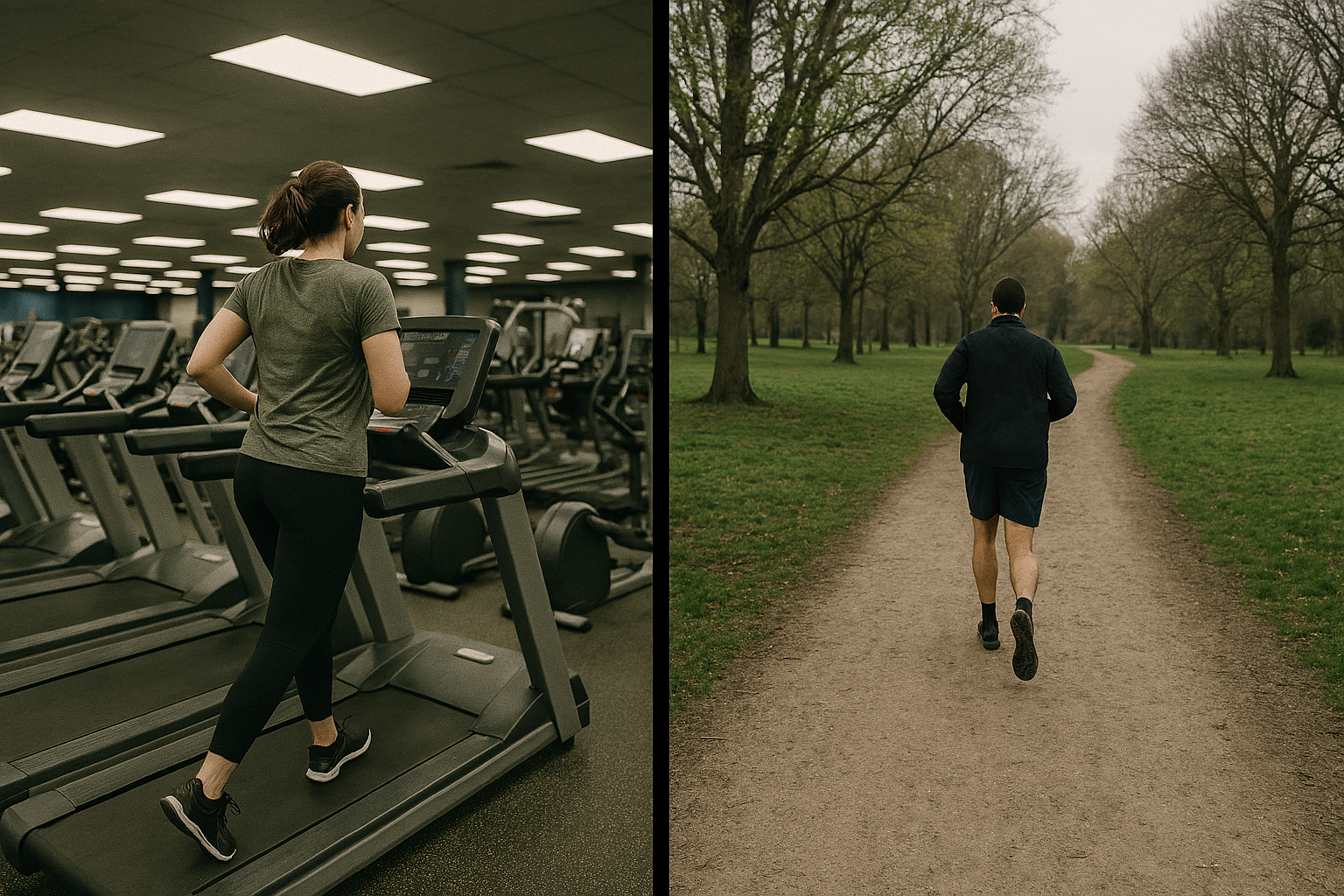
Both running inside and outside are likely to be fine for your knees. Pick according to what you enjoy or is convenient.
How to start running safely
Now that we’ve seen that recreational running overall seems to be helpful for knee pain and OA, you may be wondering how to start running safely. There are a couple of big components to consider.
One of the most helpful things you can do to set yourself up for success when starting running is to make sure that you are doing strengthening exercises. This helps your body prepare for the stresses that it undergoes during running as well as making you more efficient at running. The most important muscles to focus on are your quadriceps, glutes, and calves. Some example exercises might be squats, lunges, and heel raises to get you started. If you do them in a way that is challenging then you’ll build stronger muscles to help you with running.
Another important piece to remember is to start slow. While it can be exciting when you first start, you need to give your body time to adjust to what you are asking it to do. A good way to do this is making sure you can handle walking 2,000-4,000 steps at a time. Once you’re comfortable doing that you can alternate walking and jogging. Something like a tenth of a mile walk and then a tenth of a mile jog is a good place to start the first time you try running. After that you can increase the proportion of your jog to walk over time until you’re jogging the whole distance that you want to. Continue to build up your mileage and speed over time and don’t expect your body to be able to handle big jumps all at once.
If you’re struggling with knee pain or you want to start running and feel like you need more guidance, reach out and book a call to figure out if we’re the right fit and how I can help you.
Sources:
1. Alentorn-Geli, E., Samuelsson, K., Musahl, V., Green, C. L., Bhandari, M., & Karlsson, J. (2017). The Association of Recreational and Competitive Running With Hip and Knee Osteoarthritis: A Systematic Review and Meta-analysis. The Journal of orthopaedic and sports physical therapy, 47(6), 373–390. https://doi.org/10.2519/jospt.2017.7137
2. Dhillon, J., Kraeutler, M. J., Belk, J. W., Scillia, A. J., McCarty, E. C., Ansah-Twum, J. K., & McCulloch, P. C. (2023). Effects of Running on the Development of Knee Osteoarthritis: An Updated Systematic Review at Short-Term Follow-up. Orthopaedic journal of sports medicine, 11(3), 23259671231152900. https://doi.org/10.1177/23259671231152900
3. Burfield, M., Sayers, M., & Buhmann, R. (2023). The association between running volume and knee osteoarthritis prevalence: A systematic review and meta-analysis. Physical therapy in sport, 61, 1–10. https://doi.org/10.1016/j.ptsp.2023.02.003
4. Voinier, D., & White, D. K. (2022). Walking, running, and recreational sports for knee osteoarthritis: An overview of the evidence. European journal of rheumatology, 11(Suppl 1), S21–S31. https://doi.org/10.5152/eurjrheum.2022.21046
5. Van Hooren, B., Fuller, J. T., Buckley, J. D., Miller, J. R., Sewell, K., Rao, G., Barton, C., Bishop, C., & Willy, R. W. (2020). Is Motorized Treadmill Running Biomechanically Comparable to Overground Running? A Systematic Review and Meta-Analysis of Cross-Over Studies. Sports medicine, 50(4), 785–813. https://doi.org/10.1007/s40279-019-01237-z