
Is Lifting With a Rounded Back Destroying Your Spine?
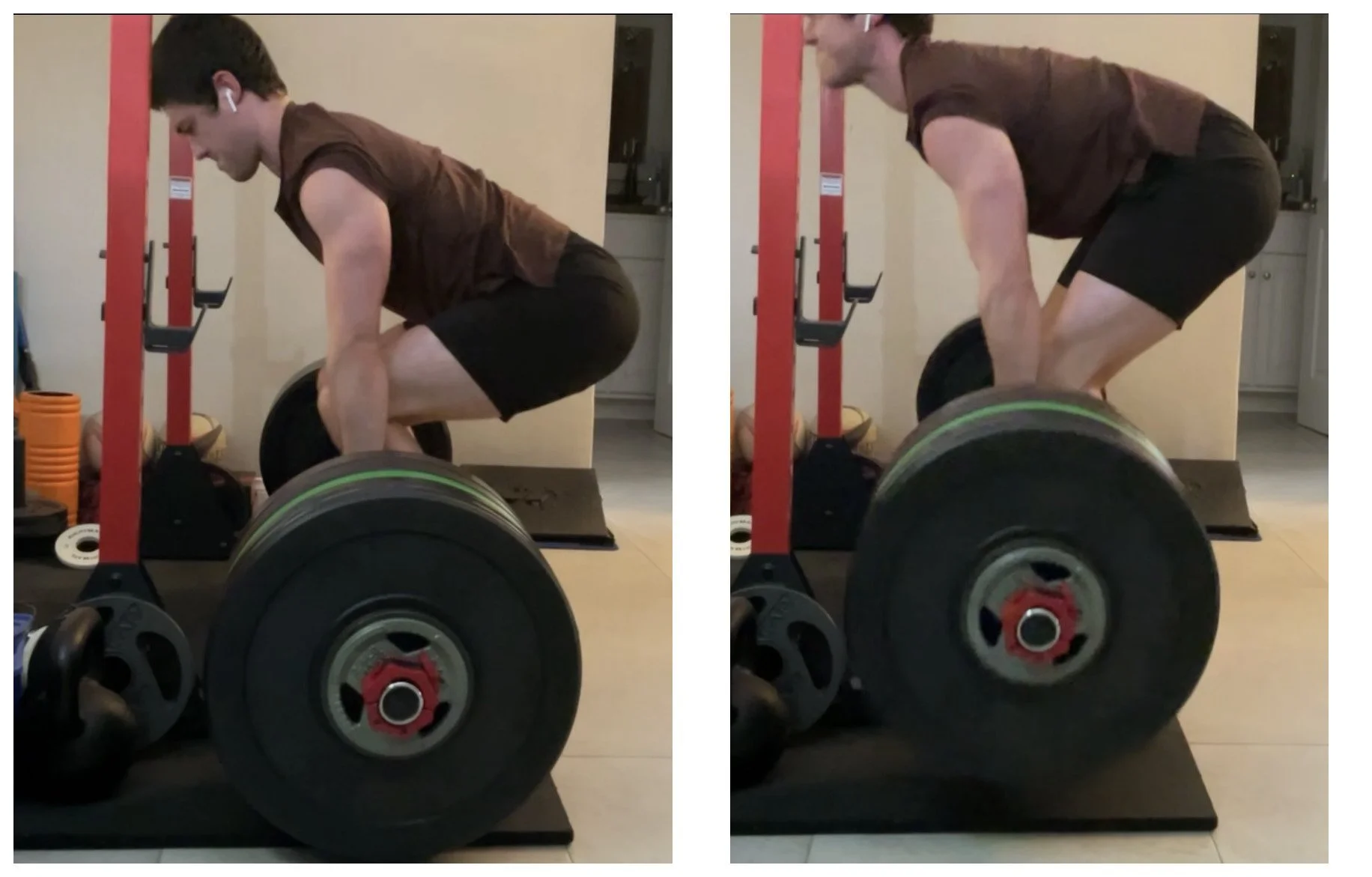
My back rounding as I try to lift 390 pounds in my living room
Most people have been told to avoid rounding their back when lifting. This advice is so common it’s treated as obvious. Keep your spine neutral, engage your core, don’t let your back round. But where does this idea actually come from, and is it as clear-cut as we’ve been led to believe?
The research behind the “neutral spine” recommendation
One influential piece of research that shaped how we think about spinal flexion came from McGill and colleagues in 2001¹. They investigated what causes disc herniation using portions of pig spines in a specially designed machine. Disc herniations can be extremely painful and debilitating, so figuring out how to prevent them seemed important.
In the study, they took cadaver pig spines and repeatedly flexed them. Some were flexed up to 86,400 times. Then they observed what happened. They found that disc herniations occurred even under relatively low forces when there was repeated flexing, and the herniations became more frequent when higher forces were used.
This research contributed to widespread recommendations to avoid spinal flexion during lifting. The logic seemed straightforward: if repeated flexion causes herniations in the lab, we should avoid flexing our spines under load. But as we’ll see, there are important limitations to applying these lab findings to real-world movement.
Limitations of Lab Studies
Looking at how spines work in isolation in a lab is a great way to generate hypotheses but they don’t show the full picture. A clear first issue is that your spine isn’t dead!
Your spine also isn’t an isolated structure in your body. It is surrounded by muscles, tendons and lots of other tissues. That means when you bend it isn’t just your spine or disc taking the whole force, it gets spread to other tissues to help absorb that load.
A further downside of using cadaver spines is that there is no chance for the spines to adapt to load. Discs are not just structures that get worn down over time. Research shows they actively remodel their structure in response to mechanical loading, with cells adjusting collagen composition based on the stresses they experience². Studies have also found that spines removed from a body don’t take back in fluid which helps to protect them from injury like a spine still in a body would³.
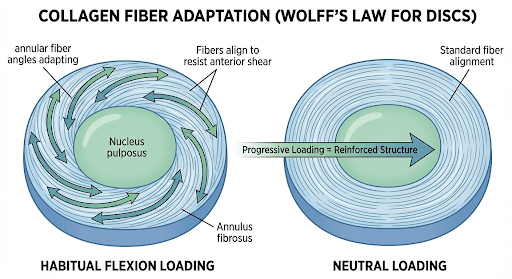
Microscopic view showing how disc tissue structure changes in response to different loading patterns (left) compared to baseline (right)
One more reason to not rush off and apply this study directly to yourself is that these spines underwent up to 86,400 flexing and extending cycles in a row. Regardless of how much lifting you are doing you probably aren’t doing quite that much! Time to rest and recover allows your body to respond to what it is experiencing rather than breaking down. It is unreasonable to expect someone’s body to tolerate running thousands of miles all in a row, yet with training people can run hundreds of miles at a time because their body has had a chance to adapt to it.
What Real-World Research Shows
It is good to know the history behind this and why some lab testing can be helpful or misleading; but the most important information to know is how does all of this shake out in the real world?
Research hasn’t found a clear link between spinal flexion during lifting and injury risk. Systematic reviews show no relationship between lifting with a flexed spine and increased back pain risk⁴ ⁵. If flexion were inherently dangerous, we’d expect to see consistent evidence of that. But we don’t.
There’s another complication. Even when people try to maintain a “neutral spine” during lifting, significant flexion still occurs. Research on lifting mechanics has found that squat-style lifts, which are typically taught as maintaining neutral spine position, still involve around 40 degrees of lumbar flexion on average⁶. This suggests that some degree of spinal flexion is normal even during lifts we consider to have good form.
Jobs with repetitive lifting have been shown to be a predictor of low back pain. Companies have spent millions of dollars trying to reduce injuries to save money and increase productivity. If the answer was simply to lift with a neutral spine back pain should be solved forever! Unfortunately, we haven’t gotten to that point yet.
To be clear, this doesn’t mean you can’t overload your back through poor load management. Very high volumes of repetitive lifting without adequate recovery can still be problematic, but that’s true whether your spine is flexed or neutral. The issue is doing too much too soon, not the position itself. A warehouse worker lifting hundreds of times per day with minimal rest is different from someone progressively training spinal flexion a few times per week.
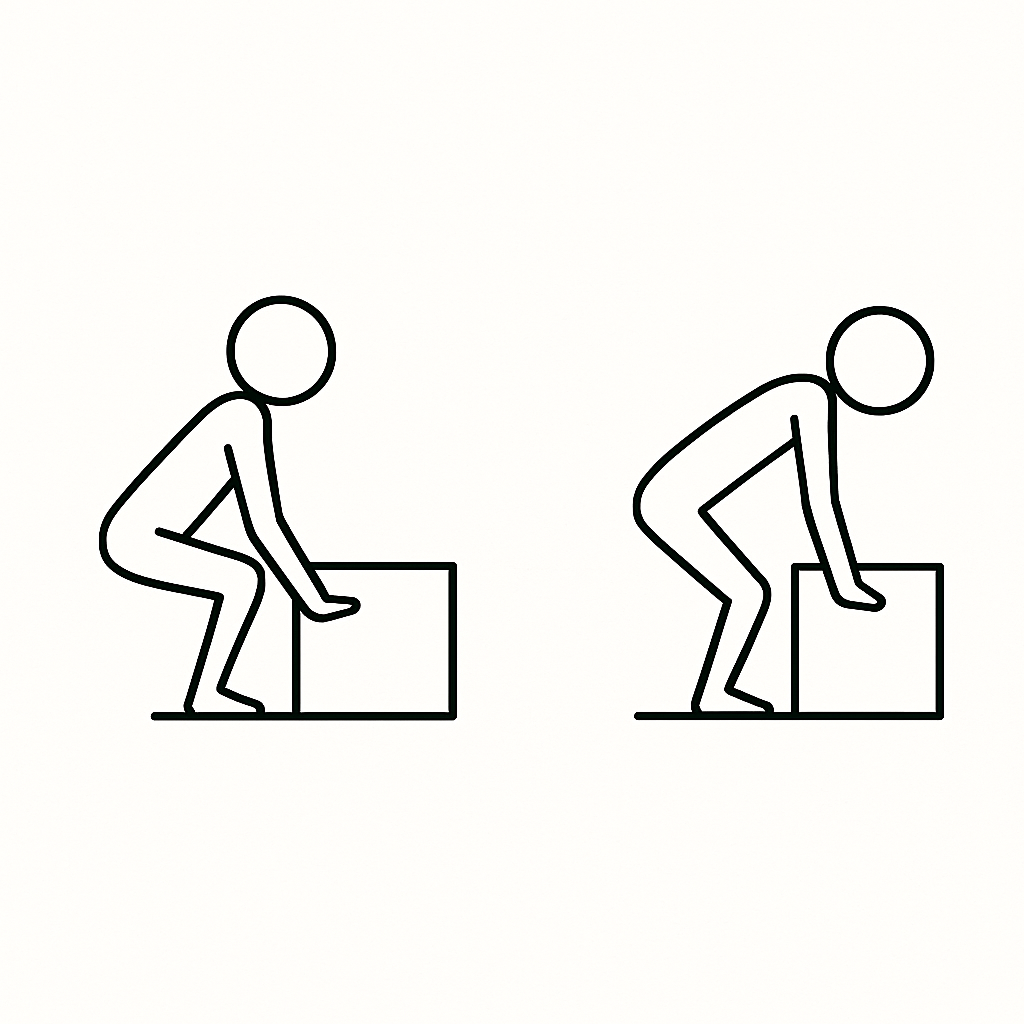
Squat vs stoop lifting. Research shows no clear difference in injury risk between these two techniques.
How to Train Spinal Flexion Safely
The research suggests spinal flexion under load isn’t the injury risk it’s been made out to be. But that doesn’t mean you should immediately start maxing out Jefferson curls.
Like any movement pattern, building tolerance to spinal flexion under load takes time. If you’ve spent years avoiding it completely, your tissues haven’t adapted to handle it. Start light. Maybe a 5-10 pound dumbbell for a Jefferson curl. See how you feel the next day. If it’s fine, gradually add weight over weeks or months.
The goal isn’t to prove a point or test limits. It’s to develop a more resilient body that can handle the variety of positions you encounter in real life. Picking up a squirming toddler. Moving furniture with your friend. Loading groceries into your car. These all involve some degree of spinal flexion under load.
That said, context still matters. Very high volumes of repetitive lifting, whether your spine is flexed or not, can be problematic if you don’t manage load appropriately. The issue isn’t the spine position, it’s doing too much too soon without adequate recovery.
If you’re dealing with current back pain, the approach is the same as with any painful movement: find a variation you can tolerate, start there, and gradually progress. Sometimes that means less weight, sometimes it means less range of motion, sometimes it means a different exercise entirely.
If you want help figuring out how to build tolerance to spinal flexion or you’re struggling with back pain and want to get back to lifting, reach out for a free 15-minute phone call to see if we’re a good fit.
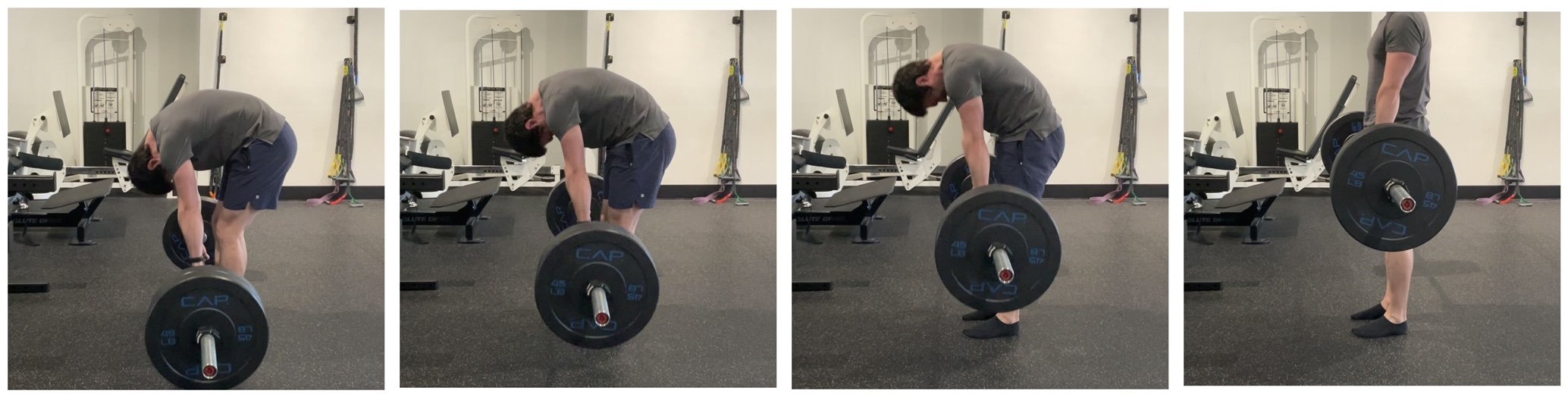
Performing a completely rounded spine deadlift or Jefferson curl with 225 pounds
Sources:
Callaghan, J. P., & McGill, S. M. (2001). Intervertebral disc herniation: studies on a porcine model exposed to highly repetitive flexion/extension motion with compressive force. Clinical biomechanics (Bristol, Avon), 16(1), 28–37. https://doi.org/10.1016/s0268-0033(00)00063-2
Brickley-Parsons, D., & Glimcher, M. J. (1984). Is the chemistry of collagen in intervertebral discs an expression of Wolff's Law? A study of the human lumbar spine. Spine, 9(2), 148–163. https://doi.org/10.1097/00007632-198403000-00005
van der Veen, A. J., Mullender, M., Smit, T. H., Kingma, I., & van Dieën, J. H. (2005). Flow-related mechanics of the intervertebral disc: the validity of an in vitro model. Spine, 30(18), E534–E539. https://doi.org/10.1097/01.brs.0000179306.40309.3a
Denis, D., Gonella, M., Comeau, M., & Lauzier, M. (2020). Questioning the value of manual material handling training: a scoping and critical literature review. Applied ergonomics, 89, 103186. https://doi.org/10.1016/j.apergo.2020.103186
Saraceni, N., Kent, P., Ng, L., Campbell, A., Straker, L., & O'Sullivan, P. (2020). To Flex or Not to Flex? Is There a Relationship Between Lumbar Spine Flexion During Lifting and Low Back Pain? A Systematic Review With Meta-analysis. The Journal of orthopaedic and sports physical therapy, 50(3), 121–130. https://doi.org/10.2519/jospt.2020.9218
Potvin, J. R., McGill, S. M., & Norman, R. W. (1991). Trunk muscle and lumbar ligament contributions to dynamic lifts with varying degrees of trunk flexion. Spine, 16(9), 1099–1107. https://doi.org/10.1097/00007632-199109000-00015