
Is Tech Neck Actually Ruining Your Neck?

“Text neck” and “tech neck” have been showing up in headlines more frequently over the past few years as people worry about their own necks or the necks of their teenagers after seeing them stare at a phone for hours. The scary claims tend to involve pinched nerves or disc deterioration from looking down at a screen. These sound alarming, but a 2023 scoping review found no clear consensus on whether text neck actually correlates with neck pain, so it is worth looking at more carefully.¹
Where the Fear Comes From
Most of the concern traces back to one study that gets cited in nearly every article and blog post on the topic.² It claims that in a neutral upright position your head weighs about 10-12 pounds, but as your neck tilts forward the load increases. At 15 degrees of forward bend it jumps to 27 pounds, and at 60 degrees it reaches 60 pounds. That’s six bowling balls worth of weight on your neck every time you look down at your phone.
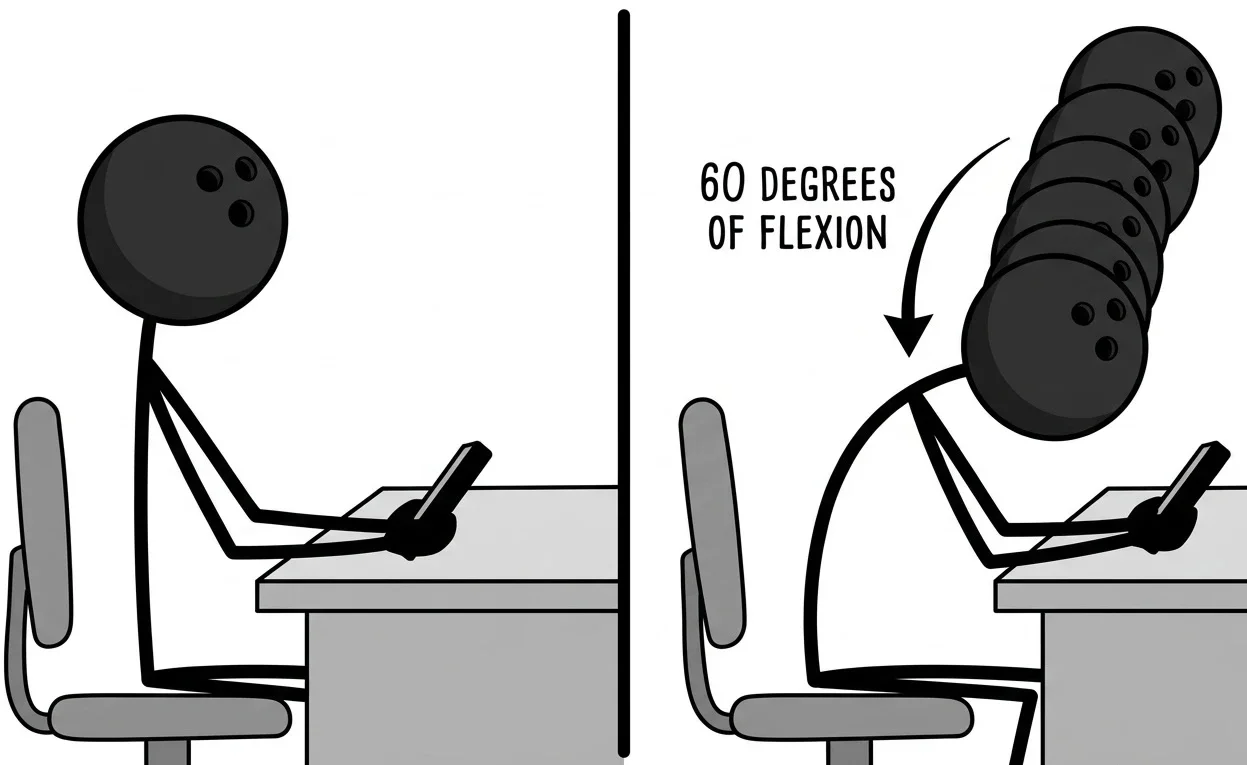
According to the Hansraj model, tilting your head 60 degrees forward increases the load on your neck from roughly 10-12 pounds to 60 pounds - the equivalent of six bowling balls.
There are a couple of problems with taking this at face value though. First, it was a mathematical simulation based on neck length and head weight, not a direct measurement of forces in living people. The model assumes load is distributed evenly across all cervical segments with a fulcrum at the base of the neck, which is not quite how your spine works in practice. Second, and probably more importantly, your body has ways of adapting to changes in load that a simulation can’t capture.
What the Research Actually Shows
If forward head posture were causing meaningful damage, you’d expect studies following real people over time to show that. They generally don’t.
One prospective study followed 17-year-olds, measured their neck posture during sitting, and then checked back five years later to see who had developed neck pain.³ In men, sitting posture at 17 had no relationship with neck pain at 22. In women, the subgroup with more forward head posture actually showed less neck pain at follow-up, though the authors note this finding should be interpreted cautiously given the complexity of the posture subgroups. A separate study of office workers who spent 75% of their workday at a computer found that forward head posture at baseline did not predict who developed neck pain over the following 12 months.⁴
Part of why the math doesn’t translate to injury risk may come down to where the bending actually happens. One study looked at spinal kinematics during smartphone use in sitting, standing, and walking and found that the vast majority of flexion occurs at the very top of the cervical spine rather than distributed evenly across all segments.⁵ For the Hansraj model to be accurate, load would need to be shared equally across all cervical levels with the fulcrum at the base of the neck. If most of the motion is happening at the top of the spine, the theoretical load numbers look quite different, and that may help explain why they don’t translate to real-world pain outcomes.
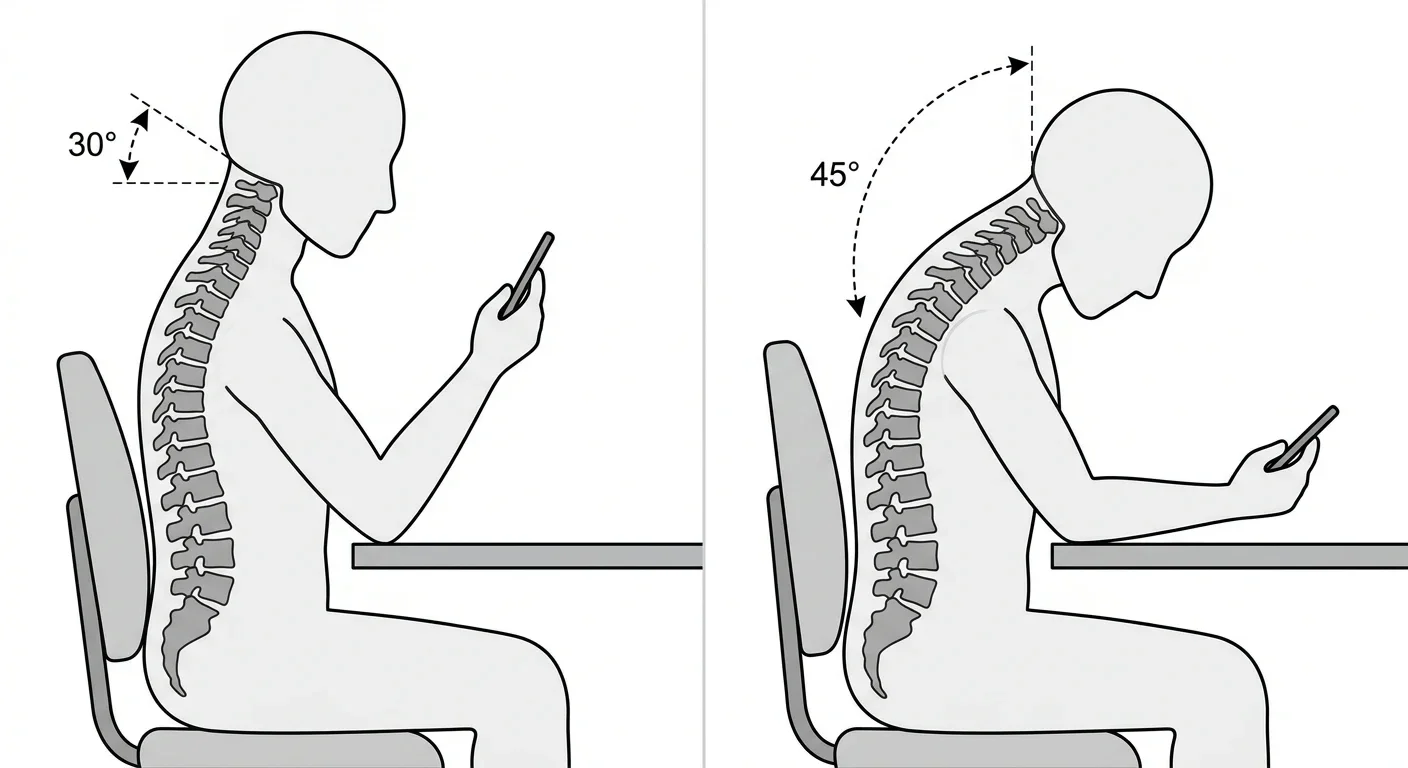
Real-world smartphone use involves a range of neck flexion angles. Research suggests most of that bending occurs at the top of the cervical spine rather than evenly distributed across all segments, which complicates the load estimates from mathematical models.
So Is Sitting at a Screen All Day Fine?
Probably not, but for different reasons than the headlines suggest. The evidence doesn’t support the idea that forward head posture is crushing your discs or pinching your nerves. The problem with prolonged sitting is less about the angle of your head and more about staying in the same position for a long time without moving. Think about what your hand would feel like if you held it in a fist for several hours. Once you moved out of that position your hand would probably feel quite sore and stiff. The muscles on the back of your neck can end up similarly irritated and fatigued, not because the position is destroying tissue, but because nothing has moved in a while. That can still be pretty uncomfortable even if it isn’t the structural disaster the headlines make it out to be.
What to Do About It
The most practical thing you can do is break up your sitting time. Getting up and moving around for a few minutes every hour goes a long way toward keeping things from feeling stiff and achy. It doesn’t need to be a formal stretching routine. A trip to get water or a lap around the office counts. An extended walk during lunch is even better. Breaking up screen time and getting more steps in is good for how you feel and for your health more broadly.
If you’re having persistent neck pain that isn’t responding to activity breaks, that’s worth getting evaluated. Reach out and we can put together a plan.
Citations:
Grasser, T., Borges Dario, A., Parreira, P. C. S., Correia, I. M. T., & Meziat-Filho, N. (2023). Defining text neck: a scoping review. European spine journal : official publication of the European Spine Society, the European Spinal Deformity Society, and the European Section of the Cervical Spine Research Society, 32(10), 3463–3484. https://doi.org/10.1007/s00586-023-07821-2
Hansraj K. K. (2014). Assessment of stresses in the cervical spine caused by posture and position of the head. Surgical technology international, 25, 277–279.
Richards, K. V., Beales, D. J., Smith, A. L., O'Sullivan, P. B., & Straker, L. M. (2021). Is Neck Posture Subgroup in Late Adolescence a Risk Factor for Persistent Neck Pain in Young Adults? A Prospective Study. Physical therapy, 101(3), pzab007. https://doi.org/10.1093/ptj/pzab007
Shahidi, B., Curran-Everett, D., & Maluf, K. S. (2015). Psychosocial, Physical, and Neurophysiological Risk Factors for Chronic Neck Pain: A Prospective Inception Cohort Study. The journal of pain, 16(12), 1288–1299. https://doi.org/10.1016/j.jpain.2015.09.002
Fercho, J., Krakowiak, M., Yuser, R., Szmuda, T., Zieliński, P., Szarek, D., & Miękisiak, G. (2023). Kinematic analysis of the forward head posture associated with smartphone use. Symmetry, 15(3), 667. https://doi.org/10.3390/sym15030667